Paglia & Beckett & Lang
I'm reading Paglia's Sexual Personae, and she sees gender everywhere (or sex for you purists). ("Gender, gender everywhere, even in our underwear!") It's waaaay too early for me to opine on this book, not only because I've read only about ten percent of it but also because I don't have a fraction of her knowledge of art and literature. But Paglia seems a sort of secular equivalent to E. Michael Jones, who also sees sex everywhere and may well be right about it.
She's read seemingly everything and has an encyclopedic knowledge. There is a 'theory of everything' aspect to her book which is always very appealing, even if wrong. "Order is charismatic" said Saul Bellow.
Steven Riddle has read the book numerous times and says she makes a strong case for a female priesthood - though interestingly enough, argues against it as well. That reminds me of how surprised I was when the conservative professor/guru Jeffrey Hart expressed support of female priests during an interview with the sainted Brian Lamb. (Anybody else notice how C-Span has sucked profoundly since he's (more or less) retired?) I used to be surprised by conservative thinkers who were Catholics (like Hart) who nevertheless disagreed with Catholic teaching. Of course it takes faith, not knowledge, to believe: i.e. "I believe that I may understand."
Reading Paglia is a good foil for reading Lang's "Why Matter Matters", which discusses the why behind the matter of the sacraments, including that of ordination. I haven't gotten to that particular chapter yet but in a gnostic, feminist culture Lang certainly has his work cut out for him.
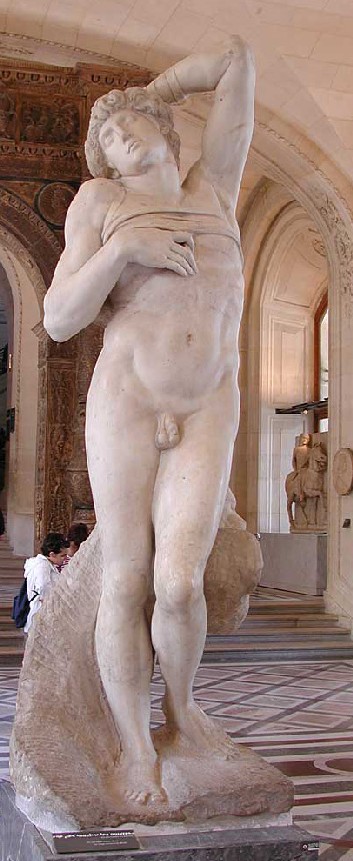
Paglia says some things I've often thought, like how academics and art historians completely miss or politely ignore the erotic aspect of so much of art, as if that has nothing to do with the price of tea in China. Her honesty is oft times refreshing. There certainly is something preversely androgynous about, say, Michelangelo's Dying Slave.
I was especially fascinated by how different Paglia's view of Emily Dickinson is from Lucy Beckett's. I guess it's one of those half-full, half-empty deals. Paglia sees her as a pagan diety (correct me if I'm wrong Steven) while Beckett writes of her attachment to Christian tradition that, "in her loneliness, without sacraments or ancient liturgy, gave her shaky but real support." Beckett says that Dickinson's response to Christianity is more often negative than positive but that "out of the mixed religious atmosphere Emily Dickinson collected a terrifying sense of God, a more terrifying sense of his absence, and an occasional, consoling sense of Christ." (The 'mixed religious atmosphere' was the dire Calvinism on one hand and the liberal Unitarianism on the other.)

No comments:
Post a Comment