February 15, 2015

A Bold One

I'm sort of hyp-mo-tized by the man in today's gospel from Mark. 

There's a shamelessness about him, perhaps born of desperation due to his leprosy.   He violates the rules by coming up to Jesus instead of walking ten paces behind.  He doesn't worry if he might infect Jesus, either due to self-interest or a potent faith. 

This "shamelessness" is heartily approved by Christ, at least until (the same?) shamelessness leads him to cavalierly disregard our Lord's warning not to tell anyone.   I wonder if you get the one without the other in a purely human way, i.e. the faith without a certain presumption? 

Bible scholar Henry Wansbrough certainly has a creative take on why Jesus angrily (the text says 'sternly' but the original Greek is harsher) sent the man away:

"It is possible that the anger is directed at the leprosy, considered as an exterior invasion, so 'sent it [the leprosy] away'. At least Jesus' whole-hearted emotional involvement with the sufferer is palpable." 

Our pastor mentioned that there was a role-reversal after:  the leprotic man could now be an open part of the community while Jesus now had to stay hidden and on the margins, lest the crowds overwhelm. 

There's an unfortunate irony in this story given how we in this day and age are told to evangelize widely and strongly but usually do not, and how this man in the gospel, told to keep quiet, did not.  What I take from this Gospel is that it's better to error on the side of shamelessness...he came for the sick, not the well.  

February 11, 2015

Maureen Dowd & Obama

So turns out that one person who really gets under Obama's skin is NY Times columnist Maureen Dowd.

It could be because he expects the liberal chorus to praise and sanctify him and she didn't play her part.

But it could also be because he recognizes a kindred spirit and it bothers him.  Just as he plays the above-the-fray psycho-analyzer-in-chief (recall this comment about gods & guns?), Mo Dowd hits too close to home given her own above the fray, psycho-analyzer of chiefs role.

It's like how in basketball teams that like to press don't like to be pressed.  Similarly, above the fray, rash psycho-analyzers don't like to be rashly psycho-analyzed by those above the fray.

Obama and Dowd come by it honestly.  As Heather King wrote, "every writer must in one way or another live 'apart' from the world."   And Obama is a talented writer as evidenced by Dreams of My Father.

Reminds me how it's always something of a toss-up as to what bothers us more: our sins mirrored in others, or sins of others that we don't have.  Might be a "both/and" situation.

February 10, 2015

A Tale of Two Commentaries


Interesting (to me at least) to compare and contrast the opinions of a theologian (Balthasar) and a Bible scholar (Henry Wansbrough) on this past Sunday's reading from Job (chapter 7): 
“Military service” is what the patient Job calls mans life on earth in the first reading. Man is no lord, but a “slave who longs for the shade”, no employer (the employer is God) but a “hired hand”. This is a general characterization of human, mortal, life. Christ and his Apostles do not contradict this description of human life. The “restlessness” that Job speaks of simply becomes the unrestrainable zeal to work for God and his Kingdom, whether through external activity or involvement in prayer.  -- Hans Urs von Balthasar
Contrast it with Henry Wansbrough's approach:
In the whole three-year cycle there are only two Sunday readings from the lovely and tragic Book of Job. The Book puts at its most acute the problem of sickness and suffering: why should I suffer? Job has lost everything, wealth, family, health. He sits on a rubbish heap, scratching his sores with a broken pot. In this passage, he gives a painful picture of the sick person’s frustration, the slow and pointless passage of time, the crazy, distorted imaginings. He feels that God is oppressing him, but yet clings to God as his one hope of release.
Undeserved sickness and death is worrying for anyone who believes in a loving God. On the natural plane, sickness is a reminder that things are out of order and could get worse. To the believer, it is a reminder that this brilliant, complicated, sophisticated creation cannot continue developing for ever, but must return to God in God’s own good time. As Jeremiah explains, the pot cannot complain to the potter: ‘Why did you make me like this?’ But couldn’t a loving God have made something so that it never went wrong? Or is it the consequence of our revolts against God that confidence in God has given way to fear and mistrust?

Weekend Linger-ances


The day grooved with the happy hour and Heat-Moon; the latter a find in my authentically-scented library (the smell of mouldering books excites). Called Roads to Quoz, it was just what the doctor ordered: a tranquil bit of armchair travel. Literary escapism on the cheap. He writes amusingly of churches ill-named (“Little Hope Baptist Church” and “Holy Ghost Disturbed Church”). He also wrote something that certainly hits close to home:
Quicker than was good for any man's mechanical self-esteem, she succeeded in stacking up a half-dozen fourpenny nails in a way I'd thought impossible ten minutes earlier. This is one of the very thing marriage counselors caution against, but men who wed a woman born a tomboy need either to sharpen their mechanical arts or to modify any notion of manly prowess based on contraptions.
I've certainly chosen the latter prescription.

*

Early day found me lounging in the pleasant pair of pre-McDonald's hours sliding down some of Chesterton's Everlasting Man via the cool, smooth surface of the Kindle. Coffee played tunes in my head. Psalms leapt from my RSV-CE2. I read a couple issues of The Economist and learned things, mainly that The Economist speaks with authority and has answers to all the world's (economic) problems.

I miss ol' Buddy, that gentle, loving presence. That reverencer of ritual with calm, dog-ensouled eyes. At McDs the older blond lady noticed the change: “Where's your other dog?” I told her we'd lost him to cancer. A momentary pause. “At least he won't bark at you anymore!” I said, and she smiled, for he was a small bane of her existence. How Buddy loved to see her startle.

At noon-thirty, a walk. How simple and yet how nourishing was that simple mile walk in the sunshine and quiet! It felt meditative and steady, awash in the natural world.  Early evening took a shower with beer at shower-side, atop the glass enclosure. One good thing about replacing curtains with glass was that now I can store the coffee thermos or beer up out of water's way and thus enjoy the decadent pleasures of beverage while under falling water.

*

Morning paper read about Marilyn of “Ask Marilyn” fame (she of the famously high IQ) about how she met her husband of going on thirty years. He wooed her by giving her his diary! Very bold move, but his transparent nature won her over. He said that their initial conversation on the phone wasn't going anywhere and he thought about just wrapping it up and calling it a day. But then magic happened and he later called that moment when he almost gave up as an 'inflection point" after which his existence was changed forever. I can so remember that inflection point for my wife and me.

*

It occurred to me today that hard-heartedness is always seen as hard-hearted towards one's neighbor, but it also includes being hard-hearted towards oneself and towards God. All three are intimately connected - there is a blatant inconsistency in our worldview if we're hard towards any human or God, since God is in and has identified Himself with humans.

Predictable Crises in Corp Life

Never underestimate the power of a saved work email. There's power in it!  Almost magical, mystical power!  Wasted six days trying to get what I got last year before pulling out le' trump card: that of the work email from the previous year.  Finally when I forwarded that note (which, thank God, I'd saved as a record otherwise it'd have been automatically erased), it jogged his memory.  "Exas", meet "perating".  My commentary in italics.  
From: Thomas
To: Jay
Date: 02/04/2015 01:41 PM
Subject: Ber. Submission
Hello Jay,
I'm doing the mort study and one of steps is to send data to Ber. to try to confirm/find deaths. 
I have the submission ready and was wondering if you're still the contact, where to put it, etc...
****
From: Jay
To: Thomas
Date: 02/04/2015 01:49 PM
Subject: Re: Ber. Submission
How big (number of lives) is your data set?
 Hmm...Not sure why that's important. I'll answer by reminding him that it's the same size as last year.
****
From: Thomas
To: Jay D  
Date: 02/04/2015 01:54 PM
Subject: Re: Ber. Submission
It's approximately the same size as last year's submission, a CSV file with about 800,000 records. 
           ****
From: Jay D
To: Thomas
Date: 02/04/2015 02:02 PM
Subject: Re: Ber. Submission
You will prob have to find a shared drive we have in common to drop the file for me.
Here is a list of mine....
[attachment "Screen shot.pdf" deleted by Thomas ] 
*****
From: Thomas
To: Jay D  
Date: 02/04/2015 02:59 PM
Subject: Re: Ber. Submission
Okay, I've copied it:
[attachment deleted]
*****
From: Jay D
To: Thomas
Date: 02/05/2015 02:05 PM
Subject: Re: Ber. Submission
What line of business are your lives from and what is the source system?
Reason I ask is I may be able to get your data from our monthly search results archive without incurring additional cost.
Rut-row....this isn't going particularly well.  I responded with the info requested and then waited till the next day before offering a helpful suggestion.
*****
----- Forwarded by Thomas  on 02/10/2015 09:19 AM -----
From: Thomas
To: Jay D  
Date: 02/06/2015 01:35 PM
Subject: Re: Ber. Submission
Maybe this is something we could explore towards the goal of implementing next year? 
         *****

Lack of response made me wonder if maybe he thought I was thinking the whole thing could be put off.
From: Thomas
To: Jay D  
Date: 02/10/2015 09:20 AM
Subject: Fw: Ber. Submission
Of course by "implementing next year" I was referring to the new solution rather than to omit submitting records to Ber. 
*****
From: Jay D
To: Thomas
Date: 02/10/2015 09:23 AM
Subject: Re: Fw: Ber. Submission
Yesd, I understand.  I am still working with your data.
Uh-oh. Time to call in the bigger guns. This is already running late. 
*****
From: Thomas
To: Jay D  
Date: 02/10/2015 09:53 AM
Subject: Re: Fw: Ber. Submission
I ran it by my director, and he said we would definitely pay the cost.   How much is it?   I can give you my disbursement code... 
Name your price, just send the data puh-lease! 
*****
From: Jay D
To: Thomas
Date: 02/10/2015 10:12 AM
Subject: Re: Fw: Ber. Submission
At $.25 per record the cost for 798,738 records is $199,241.

$199 thousand dollars?!  Holy bat scat!
******
From: Thomas
To: Jay D  
Date: 02/10/2015 10:22 AM
Subject: Re: Fw: Ber. Submission
Can you help me understand how this submission is different than last year's?  Did it cost $199k then or has something changed? 
Master of the understatement am I.  
*****
----- Forwarded by Thomas  on 02/10/2015 01:47 PM -----
From: Jay D
To: Thomas
Date: 02/10/2015 10:31 AM
Subject: Re: Fw: Ber. Submission
I would presume that we would not have sent to Ac. because of that.  
Whereupon I forward the magic email from last year.
From: Jay D
To: Thomas
Date: 02/10/2015 11:01 AM
Subject: Re: Fw: Ber. Submission
ok....In looking at the e-mail chain and the files sent and received that jogged my memory.  We sent to Ber. using our Audit search.  This is pennies on the dollar compared to sending Acc.  I will get this over today for you.

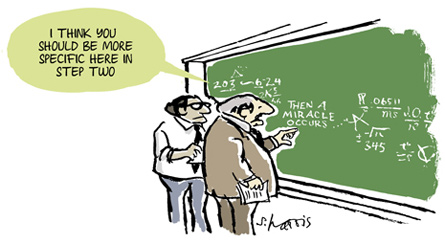
Remember this familiar ol' cartoon?  The "miracle occurs here" is producing old email:

February 06, 2015

The Limits of Language?


Interesting article on house signs at Miami University:
One needn't be a philosopher of John Blutarsky's caliber to know that fun is generally considered a constitutive component of college life. But while the traditional elements of college fun (alcohol, sex, parties ...) are similar nearly anywhere you go, its regional manifestations do vary in interesting ways. In Oxford, Ohio, home to Miami University, students living in off-campus houses celebrate and perpetuate college fun by giving their houses names and accompanying signs; these house signs tend to refer to or pun on the aforementioned traditional elements, and they serve to mark the houses as sites of additional, future fun...
"We were indeed put in the position of taking the house signs too seriously. There are a few lessons to be learned from our experience. First, I think we learned that our initial approach to house signs as being about the categories we could derive from their names is probably the approach many take. We were able to experience the shift involved in stepping out of a particular view of language – one where language is thought to have meaning that anyone can, potentially, apprehend – and into another one that depends on the habits of a group that shares some beliefs about what they are doing, or not doing, in the world. And second, we were able to show that the students living in named houses were using the names to do things that few, if any, believed they were doing. Students living in 'Inn Pursuit' and 'The Rock,' for example, wanted for their house signs to advertise their Christian faith and provide an invitation to others to join them on that basis. Students not living in such houses largely missed the significance, and reported that 'Inn Pursuit' was about sex, and that 'The Rock' was about drugs, both of which could be described as partying."

The Joys and Disputable Amounts of Fun of Parenthood

Hyp-mo-tized by this passage in Heather King's Stripped, where King profiles a lady who is really into self-mortification.  It sort of suggests that "God loves suffering!" masochisitic meme that Catholics are accused of but there is the half-ring of truth in here:
She wore vaguely bohemian clothes: berets, embroidered peasant blouses, and her smile was so brilliant that I hardly noticed the one tooth missing in her left lower jaw, the line of brown that ran along the tops of the rest. ..I suppose I shouldn't have been surprised when Barbara also expressed less than unalloyed regard for modern medicine. "Every time you have a little pain, take an aspirin, they tell you! But you never grow that way, you never learn anything! That's why I don't trust doctors. Their only goal is to avoid pain! Their biggest fear is death!"
Barbara, it turned out, had a very highly-developed notion of suffering. She believed that the suffering of animals somehow relieved ours. She believed we could and should take the burden upon ourselves to suffer for others. "You know that passage in the Gospel where the woman who's been hemorrhaging for twelve years touches the hem of Christ's garment and is healed?" she asked [Luke 8:40-56].  "Have you ever noticed which story immediately follows? It's the story of the little girl who dies and is brought back to life by Christ. And how old is the child? Twelve! Do you see? It's almost as if the woman had been keeping the child alive with her suffering...
I re-read that gospel passage a few times and lo and behold that is a remarkable thing, the 12 years hemmoraging and 12 years old. Surely not coicindental.  As familiar as I think I am of the gospels, here's another reason to keep reading them.

St. Ambrose wrote with regard to this passage, seeing in it the old coveant and new:
Why is it that the twelve-year-old daughter of the ruler was dying and the woman with a flow of blood was afflicted for twelve years, except that it is understood that as long as the synagogue flourished, the church suffered? The  weakness of the one is the virtue of the other, because by their offense salvation has come to the Gentiles. The consummation of the one is the beginning of the other, the beginning not of nature but of salvation. Exposition of the Gospel of Luke 6.56–57.10
Another gospel, from last week, was about the Kingdom of God being a mustard seed and how it starts as the smallest but becomes the largest, where the birds of the air can make their nests in its shade.  I've always thought of this as meaning I need to be that mustard seed and I need to grow large in good works to provide shade as it were.  But it occurred to me that the mustard seed is Christ!  He is the one who came so small in the world, a tiny infant of a poor and obscure mother.  And He is the one who has grown to be the largest of trees.

*

Also came across the New Jerusalem Bible editors, Henry Wansbrough's, new book "Introduction to the New Testament".  He's treads where some fear:
"Did God dictate the words? Is inspiration merely a negative protection from error? .... Cardinal Newman was worried by the fact that Nebuchadnezzar is described in Judith 1:1 as King of Assyria, when in fact he was King of Babylon."
Of course I hoped that this scruple of Newman's led him also to a too scrupulous view of chances of salvation for us non-saintly schlubs.

Wansbrough sees inspiration as an enhancement of the author's faculties, a prophet being "not so much one who foretells as one who sees as God sees."  He says inspiration is not confined to the final author of a text but is operative in the whole "process of formation and preservation of the text, observation, oral transmission (perhaps discussion), editing and final verbal expression."

He concisely describes the difficulty: "How is it possible to reconcile the inspiration of the authors with their human free will?" I like the way he put this:
"There is the curiously circular situation that the sacred writings provide the norm of the Church, but the Church decides which writings constitute the norm: the Church both forms and is formed by the Canon of Scripture. The Bible is the book of the Church: in reciprocal ways the Church interprets the Scriptures and is judged by the Scriptures." 
*

Ok, it's admittedly disturbing that I do most of my reading about asceticism while drinking beer.

*

Learned about “flow” in All Joy, No Fun, a book about child-rearing (a title applicable to our saint-making process, cross-carrying as well).   Flow is basically the idea that we are happiest when engaged in a single-minded non-passive activity we enjoy. Getting into "the zone" as it were, in an activity we can focus on and “lose ourselves” in. The book shows that parenting is the opposite of this because it's all start and stop, kids being constant distraction machines since they are wired, at that age, to be that way. Wired for discovery, for sweeping in stimuli:
    After finishing the book Flow, the reader comes away with the unmistakable impression that most adults find themselves in flow when they're alone. Csikszentmihalyi talks about fishing, cycling, and rock climbing: about solving equations, playing music, and writing poems. As a rule, the experiences he describes do not involve much social interaction, least of all with children.
It's another situation where our natural inclinations aren't always aligned with life-giving, i.e. another case of death-to-self being the secret to greater joy and life.

The book also touched on frustration:  "One study showed that 'the more willpower people expended, the more likely they became to yield to the next temptation.'"

And that temptation was usually to yell at their kids and then feel bad about it afterward.

Not a good message going into Lent!  But willpower can be strengthened, surely.  The study suggested self-control is not a bottomless resource, although of course it's not written from a spiritual perspective.

The book talked about the loss of sleep many parents experience:
“The population seems to divide in thirds when it comes to prolonged sleep loss: those who handle it fairly well, those who sort of fall apart, and those who respond catastrophically.”
It mentions studies that show parents are no happier, and often unhappier than non-parents, but it also says that the highs are higher and the lows lower with parents as opposed to married without children. It gives more meaning and reward to life.   Childcare is ranked even lower than housework on a ranked list of activities on the parental list!  A social scientist, says it's a "high-cost/high-reward activity."

The author makes the case that the parenthood today is very different from what it once was.  In some ways it's the same - such as sleep deprivation with an infant - but in other ways it differs:
1.  Choice.  Parents used to not really be able to control how large their families were or when kids arrived. "Nor did they regard their children with the same reverence modern parents do.  Rather, they had children because it was customary, or because it was economically necessary, or because it was a moral obligation to family and community (often for all three reasons). Today, however adults often view children as one of life's crowning achievements...Because so many of us now are avid volunteers for a project which we were all once dutiful conscripts, we have heightened expectations of what children will do for us, regarding them as sources of existential fulfillment rather than as ordinary parts of our lives." 
2. Work experience - two income families. With fathers much more active. "It's no accident that today's heirs to Erma Bombeck, the wicked satirist of domestic life who reigned in my mother's generation, are just as likely to be men as women. It was a man who wrote 'Go to F**k to Sleep'.  It was a male comic, Lousi C.K., who developed a grateful cult following of moms and dads." 
3. Childhood completely redefined. Children used to work and not be shielded from life's hardships.  Now they are protected. "Children stopped working, and parents worked twice as hard. Children went from being our employees to our bosses." 

February 02, 2015

Super Bowl Recap

Well, now, that was some superb entertainment. Especially when, like me, you watch the game about an hour behind via DVR and fast-forward through the huddles so that the game action is down to a manageable thity-five minutes. I am glad I didn't post my almost-tweet "Cheaters never prosper!" given New England's comeback. That goal-line pass had the whiff of useless tragedy about it, didn't it? I had no positive feelings for either team and intended to watch only the commercials (towards the goal of understanding where our culture is going1).

The festivities began with a lacklustre yet overwrought national anthem, followed by a remarkably named college as said on international television by a Seattle player: "The University of Vagina". As is my wont, I immediately went to Twitter only to be semi-disappointed to learn that he'd said "The University of Regina". Oh...Oh well. These are the times that titilate a man's soul. The prank that wasn't.

*

The commercials were similarly a mixed bag. Nationwide Insurance wanted to start a national conversation about child safety but instead started a national conversation on the advisability of killing the collective buzzes of millions of people. It's the old story of "just because you can do something, even if for good intentions, doesn't mean you should."

It also was offensive to me because there was a sort of huge missing the forest for the trees aspect as illustrated by this:


I was intent on having My Voice Heard, by voting on the USA Today admeter, an exercise in silliness if there ever was one. I'm was taken aback by the amount of privacy these sites want to invade. Sex, age, income. For income I said " under 25,000" as my way of saying, "none o' your business."

1 - I give and I give. 

January 30, 2015

Turn Your Tweets to "Poetry"

....Via the magic of http://poetweet.com.br/?lang=en:
Understands 5%
by TS O'Rama

Due to its religious content.
Should be split into 3 countries.
"Homesick for the Present"
Been hacked by intolerant lefties.
Thanks to '51 iconic recording.
Aires | Catholic World Report
No matter the song she's singing.
More than a week."-Guy Davenport
Funny line from Henry Dieterich
Even better in the original German.
Too soon, making her lazy if rich
True causes of Irish famine:
Effective (in some quarters).
The Sistine stays in the Sistine.
*
Work overtime
by TS O'Rama

Or Jeb Bush. I like Rand Paul.
Away from my months-old open one.
And is playing for the long haul.
It's what's supposed to be done!

Praised in Wall Street Journal.
Hasn't studied crime demographics.
It's that Vietnamese cardinal?
National Characteristics

The perception that he is humble.
The reference is too obscure.
The higher education scam/bubble:

Aires - Catholic World Report
Effective (in some quarters).
More than a week, Guy Davenport

Friday Seven

Tired, he wrote. Yesterday's pure prairie league of fatigue led to a sort of mini-euphoria due to and accentuation of my beer-quaffing.

Fell into a new novel, just $1.99 (a Kindle daily deal) and it was all reverie. Wilderness it's called, by Lance Weller. Marvelous collection of words that massaged the brainstem.

*

Grow close to the brine
Suckle at her salty tit.

*

I read somewhere recently something commonsensical: that if one is not ambitious and thus choose not to make much money then there must be self-discipline to not to consume much; i.e you can't spend what you don't earn. And I think there's a corollary as far as having sex and having kids. If you choose not to have kids then you are in effect choosing to have self-control in the area of sex. Sex and kids are joined, or should be, as firmly as spending and earning.

*

Read article via Drudge that boys who have been circumcised more likely to become autistic. Owie - don't cut our pickles!  No causation proven, just correlation but whether true or not there could be a correlation between stress levels felt in adults and whether there was a traumatic experience in early youth.  From a scholarly article titled “Psychosocial implications of pediatric surgical hospitalization”:
The prevalence of childhood surgical illness and injury requiring hospitalization suggests the need for implementation of an applied intervention to decrease levels of anxiety in these patients. When psychological concerns are not addressed in the present moment, potential for long-term negative psychological effects occur. To respond to the psychosocial needs of pediatric surgical patients it is important to understand foundational stages of development. Age is not always directly correlated with developmental stage and attunement to this subtle differentiation is essential. 
*

I'm not sure if it's theologically accurate, but I always imagine that when Jesus came to earth he had a choice that was not immediately clear. One that He would have to discern over time. And that is whether to judge the world or to save it. In the OT, there were certainly prophecies of the ghastly day of Judgement, when God would avenge his enemies. (Of course that will still happen, with the Second Coming.)

One Bible commentary opines that John the Baptist was shocked and surprised that Jesus was as mild and merciful as he was. I think John expected the OT prophecy coming true at that particular time.

Jesus certainly had many harsh words for the people of his age. He called them weak of faith, hypocrites, fools, and even wicked. So the time was ripe for judgment, certainly and Jesus would've been well within his rights, as God, to have chosen to destroy rather than rebuild. To not, in other words, die on the Cross. But over time I think He discerned the Father's will for him as coming to save, to redeem, via his own sacrificial death. He saw that Isaiah 53 (“the suffering servant”) applied to him more than the prophecies of Malachi at that time.

*

Took puppy Maris on a inaugural walk and she slipped the leash and I had to make a citizen-stop on a car coming and then attempt to wrangle Maris back under leash. Scary because she is only about twenty times faster than me and doesn't respond to voice commands. A bad combo.

Disturbing to read article the other day about the introduction of furry, cuddly robots to seniors for companionship. On the one one hand, I think of how young girls played with dolls and senescence of age suggests a second childhood. On the other hand, doesn't human interaction provide something intangibly greater, much as the bread of Eucharist conveys far more than mere bread? At the very least companionship in the form of living animals seems preferable, let alone humans.

The secular author sounds like recent popes:  “We seem determined to give human qualities to objects and content to treat others as things....Artificial pets don't require cleanup, are lovable and responsive, and never die..Technology is seductive when what it offers meets our human vulnerabilities."

*

What if the mother's love, sometimes discredited for its bias, was God's too?

*

Here are things that people do that make me feel served, that make me feel like I should be working harder to make others' lives better:

    Symphony musicians
    Lyrical writers
    Massage therapists

They say the mark of artistic excellence is that it looks easy even though it's hard, i.e. Joe DiMaggio instead of Pete Rose. But that doesn't inspire me the way it does when I see someone working hard and doing something well, like a violin virtuoso with electrically-charged moves and head bobs, or a writer who jams novels with evocative scene-settings (spare me a spare Hemingway), and massage therapists who knead and tenderize muscles with verve.

*

Found on the web:
One of the things that is lost when there is too much wealth or when values are misunderstood or we have become accustomed to injustice, to this culture of waste, is the capacity to cry. This is a grace we must ask for. -Pope Francis
And…
    We students read his The Crisis of Our Age (1941) in which he developed his then famous theory of cultural cycles. He argued that cultures move from ideational forms in which transcendent truth claims and moral norms are the organizing principles of social life, to idealistic cultures, which blend ideational and “sensate” aims, to sensate cultures, which focus exclusively on sensory perceptions and experiences. This latter stage rejects transcendent values and slides into decadence and chaos, out of which is born a new ideational culture. The transitions between cycles are characterized by violent upheavals. Sorokin thought the period of World War II was such an upheaval, one which marked the end of a sensate cycle and presaged the dawning of a new ideational phase.

*

Too too funny, from Jonah Goldberg:
My buddy James Lileks writes about how left-wing students at Berkeley (sort of redundant, I know) are starting to turn on Marx, not because of his potted theories of the dialectic, his crude reductionism of man to homo economicus, or even the fact that he set the foundation for turning the 20th century into an abattoir. No, Marx is bad because he’s just another dead white guy. The students write in the school paper:
We are calling for an occupation of syllabi in the social sciences and humanities. This call to action was instigated by our experience last semester as students in an upper-division course on classical social theory. Grades were based primarily on multiple-choice quizzes on assigned readings. The course syllabus employed a standardized canon of theory that began with Plato and Aristotle, then jumped to modern philosophers: Hobbes, Locke, Hegel, Marx, Weber and Foucault, all of whom are white men. The syllabus did not include a single woman or person of color.

The Black Community

It's sort of fascinating to me how communal the African-American community is. I mean but wow, just the voting record alone (i.e. 90-95% for Democrats) puts Catholics to shame given that we can't even agree to refrain from voting for a pro-abort politician.  

What's the secret? Black community seems to thrive in part due to shaming ("Uncle Tom" and "Aunt Jemina" for those accused of going outside the fold), skin color over materialism, efficiency or safety, and a shared history of persecution (and a lively sense of current persecution).  There's even a substitute national anthem! Sometimes you have to wonder at how much our melting pot has melted, and whether e pluribus unum is a convenient fiction.

Some selections from the book  Devil's Night: And Other True Tales of Detroit: 
Most black Detroiters do not measure their lives, or their city, by the yardsticks of the American middle class. [Mayor] Young may not have provided them with the safest streets or most efficient services; nor has he been able to raise their standard of living. But he has given his constituents something even more valuable: a feeling of empowerment and personal worth. Detroit is one of the few places in the country where blacks can live in a sympathetic, black-oriented milieu.
Kim Weston sang black America’s national anthem, “Lift Every Voice and Sing.” This, too, is standard Detroit practice. On occasions when the presence of white dignitaries makes “The Star-Spangled Banner” necessary, the master of ceremonies invariably follows it by saying, “Now we will sing our anthem,” and “Lift Every Voice” is performed.
Unfortunately for [candidate] Barrow, these same qualities were interpreted by blacks as a lack of ethnic authenticity. In a city where blackness is equated with street-smart militance, he didn’t seem like the real thing...Unexpectedly, he veered off into a defense of his own racial authenticity. He mentioned the fact that he had been born in Black Bottom and raised on the east side, in a black neighborhood, and he recalled boyhood trips to the segregated South. “I remember having to drink out of the colored water fountain,” he said, his flat Michigan inflection taking on a southern tone.
This was Detroit, not America, and in the black polis, all politics are ultimately about race. The mayor did not object to competence (a good case could be made that he is a far better manager than Barrow), but it was beside the point. To him, the issue was, as always, protecting Detroit’s black integrity and independence from the suburbs.
A television reporter picked up a red-and-gray booklet from a coffee table and began to thumb through it. Entitled Hit the Road, in honor of Young’s famous challenge to the city’s hoodlums, it was written by someone called “King George” Cunningham, Jr., and published in 1974. Several of the journalists gathered around and guffawed at Cunningham’s overblown prose. “Look at this,” one said, turning to page 19, and read aloud: “Thank you, Jesus. We’ve got a new god, Coleman.”

January 21, 2015

Reviewer Nails It

Yes! Somebody else sees the naked emperor that is "Forrest Gump". From Rolling Stone:

"This is the same Hollywood culture that turned the horror and divisiveness of the Vietnam War era into a movie about a platitude-spewing doofus with leg braces who in the face of terrible moral choices eats chocolates and plays Ping-Pong. The message of Forrest Gump was that if you think about the hard stuff too much, you'll either get AIDS or lose your legs. Meanwhile, the hero is the idiot who just shrugs and says 'Whatever!'whenever his country asks him to do something crazy.

Forrest Gump pulled in over half a billion and won Best Picture. So what exactly should we have expected from American Sniper?"

January 20, 2015

Finds Found on the Web and Elsewhere

Here's the thing about biomechanics. Everything is interrelated. How we move at the ankle affects the knee and the hip, then the pelvis and the spine. How we sit affects the pelvis, then the spine above and our legs below. How well our spine moves affects how well our arms move. Beginning to correct things in this chain brings about changes you would not expect. One of the books that I've been reading is Move Your DNA. I absolutely love the point that it makes that what we perceive as normal (because everyone around us moves the same way) is not actually optimal. It's not how we were made to move, and it's not the best we can do. We can do better....I don't know if I can fully explain this on a biomechanical level, but it is a cascade of effects. 
Fully understanding the dignity of the human person is not easy, but it is so important. I can't help but think that some of this horrible violence is because people do not understand their own dignity and worth, much less someone else's. Certainly, there is a chaos that is happening with regard to what we consider "okay" in terms of relationships and having children. We are not even certain what all effects these are having on people in day to day life. 
*

Fascinating thoughts from art historian Kenneth Clark on the history of the female nude:
Since the earliest times the obsessive, unreasonable nature of physical desire has sought relief in images, and to give these images a form by which Venus may cease to be vulgar and become celestial has been one of the recurring aims of European art….
Following Plato's example, we might call them the Vegetable and the Crystalline Aphrodite. These two basic conceptions never quite disappear, but since art involves the application of laws, the distinction between the two Aphrodites grows very slight; and even when most unlike one another they partake of each other's characters. Botticelli's Venus 'born of the crystalline sea of thought and its eternity' has a piercing strain of sensuality; Ruben's Venus, a cornucopia of vegetable abundance, still aspires to the ideal. 
*

Who's up for an international conversation about Islam?  Because, you know, if we just had a national conversation on race it would clear everything up.

Bill O'Reilly made a trenchant point the other day:
Mr. Abdul-Jabbar [writes]:
“Knowing that these terrorist attacks are not about religion, we have to reach a point where we stop bringing Islam into these discussions. I know we aren't there yet because much of the Western population doesn't understand the Islamic religion.”
That's true. But here's what Mr. Abdul-Jabbar is missing: Much of the Muslim world does not understand the Islamic religion. Take Pakistan, for example. It allows the Taliban – major human rights violaters – sanctuary. Is that permissible under Islam? Apparently, the government of Pakistan believes it is. How about Turkey? It will not assist the West in fighting the ISIS killers on its border. Does Islam condone the beheading of innocent people? Doesn't the Koran state that a good Muslim protects the innocent and fights against injustice? Apparently the Turkish government does not understand the Islamic religion either. I could give you dozens of other examples from wealthy Islamists funding al Qaeda and ISIS to Sharia law being used to abuse women on a massive scale.

January 16, 2015

Too Funny

From Jonah Goldberg:
It’s true that the Obama administration has had remarkable success playing word games. They “created or saved” millions of jobs — as if that was a real economic metric. (For what it’s worth, I do or save 500 pushups every morning).

Short Takes Friday (as begun by Jennifer Fulweiler)


Interesting comments from ebook reader subscription firms:
Zacharius of Kensington: Data we receive from subscription services is very interesting. Some people take 6 months to read a book.
Scribd:  Lots of people get two thirds through a book and don’t finish. Surprising.
*

Sighted on Zippy Catholic:
"This is to show the world that I can paint like Titian. Only technical details are missing." – Wolfgang Pauli, caption for a blank page
*

Am impressed by the regnant glow of John the Baptist's humility. Just before his rightly famous “I must decrease, he must increase,” there were other piquant quotes. I'm moved by the fact St. John was moved by being merely the “best man” at a wedding. He'd effectively played matchmaker, asking his countrymen (the bride) to give up their sins before the coming wedding banquet, and then introduced them to the man next to whom he was not worthy: “The very reason why I have come, with my baptism of water, is to make him known to Israel.” When John's disciples seemed disgruntled at the attention Jesus was getting, John told them:
“A man must be content to receive the gift which is given him from heaven, and nothing more.” (Knox)
Alternative rendering:
“A man can only have what God gives him…He who comes from above is above all others.” (NEB)
I love the matter-of-fact humility where John sort of shrugs and says, “I only have what I've been given. I'm not God.” Nor can we, though we enjoy playing god in our daily life.

*

Interesting article in the newspaper discusses Generation X   We are said to have demanded and got a better work-life balance than generations previous in part due to one song: Harry Chapin's Cat's in the Cradle.  I think to deny the power of popular culture is a mistake and that haunting three-minute song seemed to sear its way into our collective consciousness.

The article says those born in the mid-1960s watched the "fires of social upheaval" and "chaotic convulsions....The 1970s oil crisis, for one, had knocked the wind out of the global economy and helped trigger a stock-market crash, soaring inflation and high unemployment...The younger baby boomers and Gen Xers share a sense that it’s a cruel world out there, that the economy is not unlimited,” said Paul Taylor, a senior fellow with the Pew Research Center.

You'd think that those who realized the economy is not unlimited and that things are precarious would save more money, just as folks raised during the Depression would later do, but I'm not sure the savings rate of GenX'rs is anything to write home about.

*

I see our state governor's daughters, depicted with him at his swearing in, in the Columbus Dispatch.  One is wearing a dress short as the late Little Jimmy Dickens. It's the style these days I suppose. I check Twitter to see if anyone has commented inappropriately (because that's what Twitter's for) and one ne'er-do-well says the gov's daughters are "boots".

I have no idea what that means, of course, but via the miracle of the internet can instantly decode slang.  Hipsters beware, we can read your thoughts.

I'm old enough to remember a baseball player called Boots:  Boots Day. Played for the Expositionals (Expos).

*

Killed some time the other day watching Joe Biden administer the oath of office and pose for pictures with the new Republican senators. It was oddly compelling if only for watching a political master glad-hander in his glory, his face Botox'd and plastic surgically enhanced. He's a throwback to the old Irish pols of yore. He greeted the children and family members as if they were God's gift to the world, and so they are.

*

I read a Christianity Today article that said most sin is simple excess. The sin of anger is when it gets carried too far, into bitterness or rage or unforgiveness. The sin of sadness or despair is when it becomes excessive. The sin of lust is sexual desire excessive and contrary to reason.

In fact “contrary to reason” seems the key. To be reasonable is practical and thus kind of boring but surely quite religious and moral. Virtue is often the “middle way” between extremes.

I read yesterday of the almost superhuman chastity of Joseph, son of Jacob, in Egypt. How the Pharaoh's wife begged him to have sex with her. And he loved his wayward brothers without bitterness. Joseph really seems like THE saint of the OT. You can have your Elijah and Jeremiah and maybe even Job. Joseph seems otherworldly in terms of forgiveness, maturity and love. He seems like a New Testament figure.

*

Embarrassing that MLK's children are constantly suing each other. The latest is that the two brothers are suing the sister in order to sell MLK's personal Bible and Nobel Peace Prize.

It's interesting that it's come to this - the selling of the most personal objects left. All his personal papers have already been sold for tens of millions of dollars. Hard to underestimate the need for greed.

If the brothers have their way, which they likely will, what will the sons and daughters of Martin Luther King have to pass on to their children of a sentimental value? It's ironic the great preacher of peace and harmony couldn't pass that down.

MLK used the court system to try to effect justice on behalf of his people, and his children appear to use the court system to fight among themselves for their own benefit. You can see the devolution of society right there. Jesus wanted to make things right for us, with no benefit to himself. MLK wanted to make things right for African-Americans. MLK's children want to make things right for themselves. A metaphor for our age.

*

Heard priest homily the other day - he said what he finds most moving/inspiring about the priesthood.  It's that grown men cry in front of him when they realize the love God has for them.  That makes it for him.   He asked when was the last time we cried over the same realization.

*

Suggested to Steph another potential name for our new puppy: “Maris”, short for “Stella Maris”, a title of Mary's and the name of a dog we met in Hilton Head. Surprising to me, she loved it and moved it near the front of the list, right up there with “Faith”.

*

Blogs mean never having to say you're sorry for asterisked segues.

*  (hey, there's one right now, stage left!)

Hope via St. Basil:
If we devote ourselves to imitating the saints, then no matter which virtue we feel ourselves lacking, we can fine in Scripture, as if in a medical clinic, the proper medicine for our particular ailment. Whoever is focused on chastity, for example, can reflect on the history of Joseph in the Old Testament. We learn from him chaste actions. We find him well disciplined - firm in self-control with regard to pleasure - and we see him making virtue a habit.